
 Services
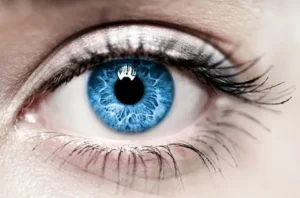
The pupil is not just a «hole» in the eye. It is regulated by the autonomic (vegetative) nervous system and normally responds to light, distance to an object, and emotional state. But can you control it voluntarily without changing the lighting?
Scientific answer
Yes, partial voluntary control over the pupil is possible, but it is quite limited.
A person cannot fully «turn on and off» the pupil like a light switch. However, many people can consciously change its diameter within 0.5–2 mm, and some even more.
How does it work?
The pupil dilates under the influence of the sympathetic nervous system (fight‑or‑flight response) and constricts under the influence of the parasympathetic system. Although this process is mostly automatic, there are connections between the cerebral cortex and the centres that regulate the pupil. That is why thoughts, attention, emotions, and even imagination can affect pupil size.
Real examples and research
Classic experiments: As early as the 1960s–1970s, psychophysiologists showed that people could increase or decrease their pupil size if given appropriate biofeedback. For example, subjects learned to dilate their pupils by imagining dark or frightening images.
Yogis and meditative practices: Some yoga and meditation practitioners demonstrate noticeable control over the pupil. The literature describes cases where masters could significantly dilate their pupils in a well‑lit room using breathing techniques and concentration.
Emotional control: It is known that during intense sexual arousal, fear, or sudden interest, pupils naturally dilate. Some people can mentally induce these states and thus influence the pupil.
Modern research: In the 2010s–2020s, neuroscientists (using functional MRI, for example) confirmed that voluntary pupil control is associated with the prefrontal cortex and the locus coeruleus, the centre responsible for alertness and arousal.
How much can the pupil be changed?
- Average person: change of 0.5–1.5 mm.
- After training: up to 2–3 mm (rarely more).
- Fully dilating the pupil to the maximum (as in complete darkness) or fully constricting it (as in bright sunlight) by willpower alone is practically impossible.
How people train control
The most common methods:
- Biofeedback – using special equipment that shows pupil size in real time.
- Visualisation – imagining dark or bright scenes.
- Breathing techniques – deep slow breathing often helps dilate pupils.
- Focusing attention – concentrating on near or far objects (though this is partially related to accommodation).
Conclusion
Consciously managing pupil size voluntarily is real, but human capabilities are very limited compared to the automatic response to light. Complete control, like that over arm or leg muscles, cannot be achieved. It is rather a subtle neurophysiological ability that is best demonstrated by people with good control over their attention and emotional state.
If you are interested, you can try simple exercises with a mirror in a well‑lit room: attempt to dilate your pupils by imagining fear or a dark space, and constrict them by focusing on a close object and calmness. Some people manage it better; for others, the change is barely noticeable.